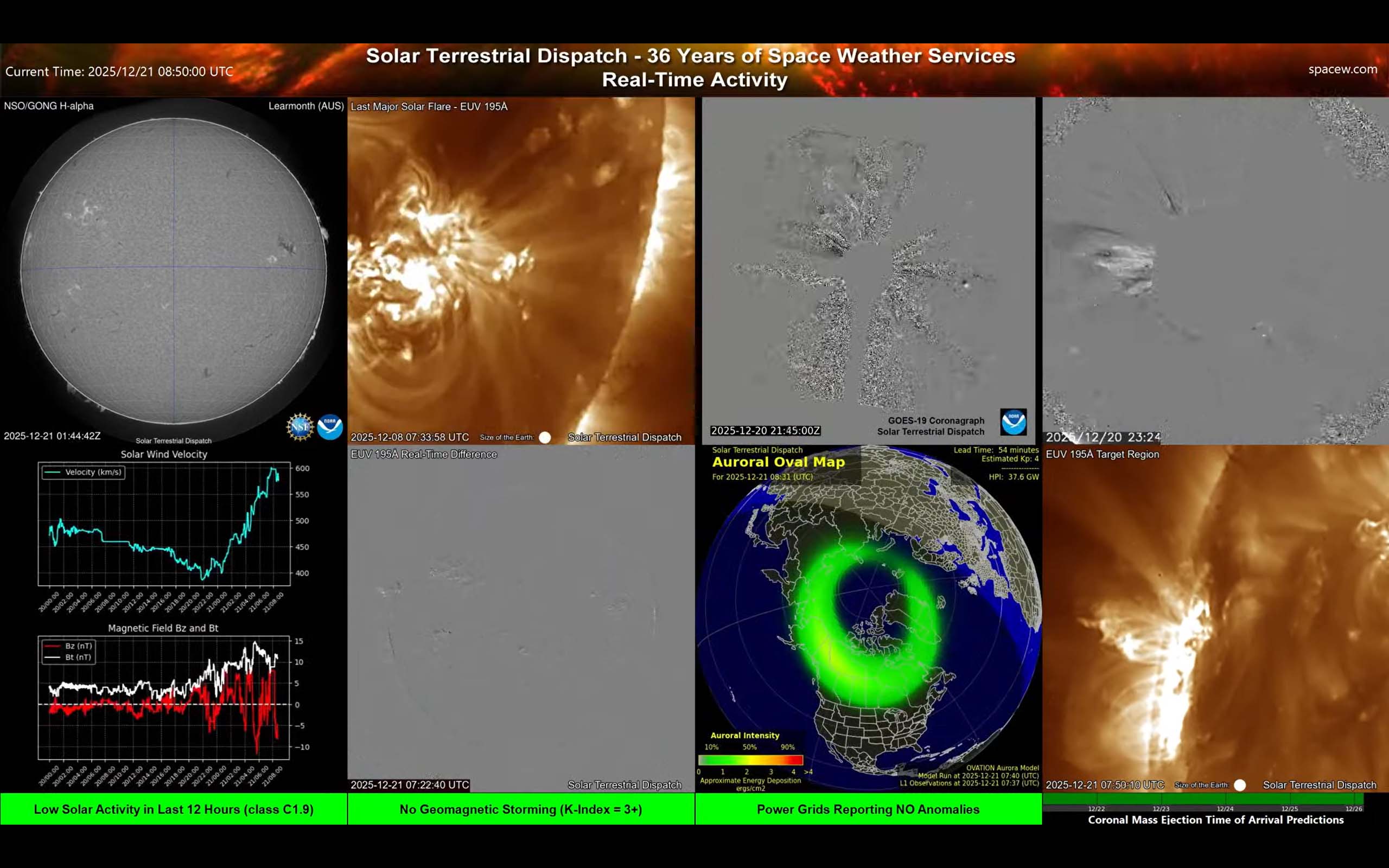
Screen 3 — Real-Time Activity + Near-Earth Solar Wind + Auroral Oval
Summary
This screen connects the Sun to Earth. In addition to solar images and coronagraphs, it adds the near-Earth solar wind speed and the solar wind magnetic field (especially Bz), plus an auroral oval map indicating where aurora is most likely right now.
More detail
What you’re looking at
- Solar wind speed (km/s): How fast the solar wind is flowing near Earth. A rising speed can signal arrival of a fast stream or CME flow.
- Magnetic field Bt and Bz: Bt is overall strength; Bz is the north–south direction. Bz is a major “aurora switch.”
- Auroral oval map: A model-based estimate of where aurora is most likely; a larger/brighter ring can mean aurora reaching farther from the pole. This model estimates where auroral activity should be visible directly overhead.
How to interpret it (simple rules of thumb)
- If Bz is strongly southward (negative) for a while, Earth tends to couple more energy from the solar wind → aurora chance goes up.
- High speed helps, but speed alone doesn’t guarantee aurora. The direction (Bz) is more important. A high speed and a southward Bz are almost always associated with auroral activity.
- Use the oval model as a guide, not a promise: clouds, local darkness, and timing still matter.
Practical tip: If you only have time to look at two things for aurora: check Bz and the auroral oval. Then confirm with ground magnetometers (Screen B) or polar orbiting spacecraft images of auroral activity (Screens E and F).