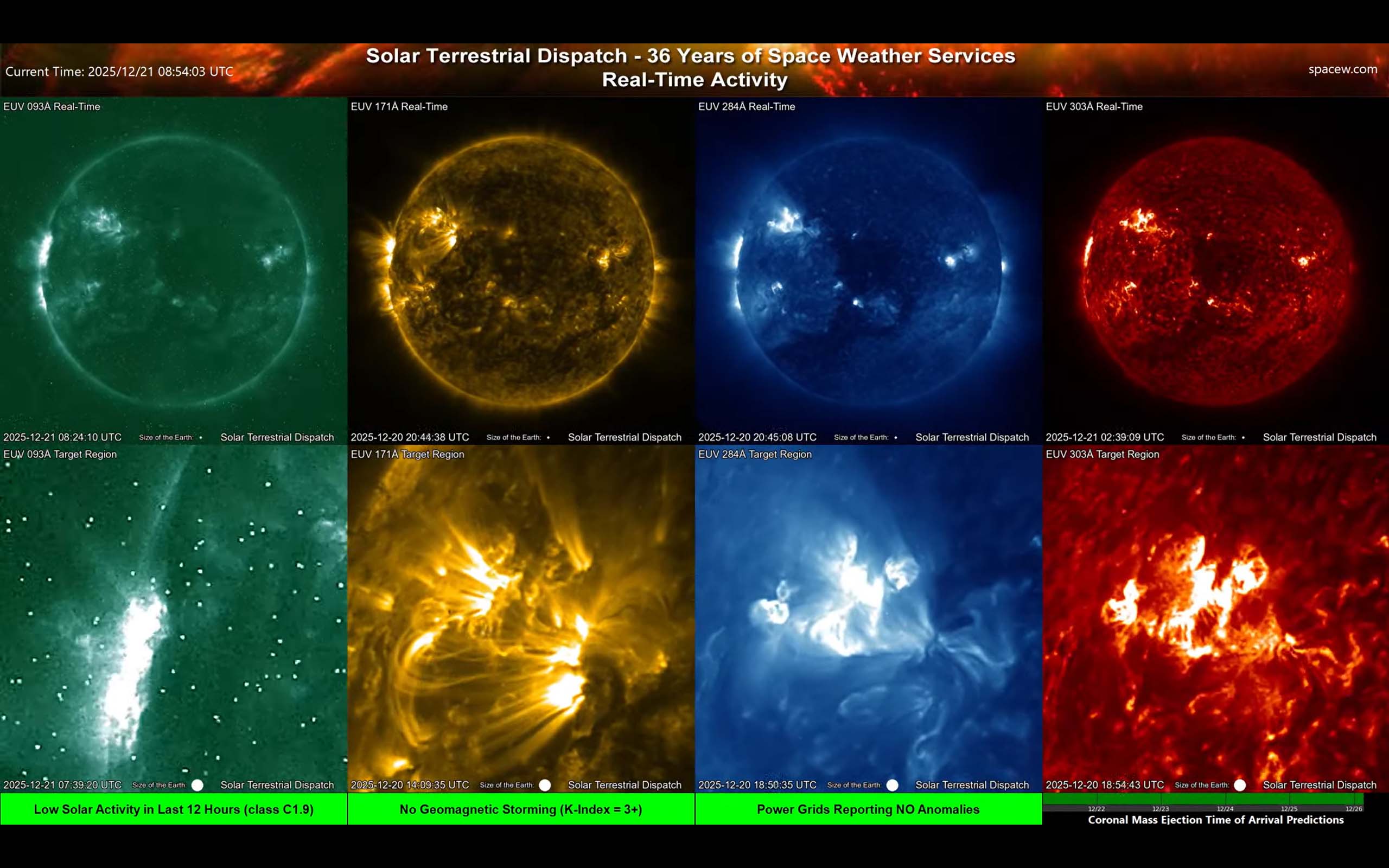
Screen B — Four EUV Channels (093Å / 171Å / 284Å / 303Å) + Target Region Zooms
Summary
This is a “multi-layer” view of the Sun using four different EUV wavelengths. Each wavelength highlights plasma at different typical temperatures and in different layers of the solar atmosphere. The bottom row zooms in on the current target active region so you can compare what the same region looks like in each channel.
More detail
Main idea
These are false-color images: the colors are chosen so we can easily see structure. What matters is that each wavelength is sensitive to different conditions, so the same region can look very different.
Top row: full-disk views in four channels
- 093Å: Often highlights hotter coronal structures (including very hot flare-related plasma). Great for spotting “energetic-looking” cores.
- 171Å: Shows common coronal loops and quieter corona structure very clearly. This is often one of the easiest channels for beginners to recognize loop shapes.
- 284Å: Tends to emphasize somewhat hotter active-region corona and bright cores.
- 303Å: Shows cooler upper-atmosphere features (prominences/filaments and flare ribbons can stand out strongly).
Bottom row: “Target Region” zooms
- What it’s for: Compare the same active region across channels.
- What you learn: Some structures are only obvious in certain channels. For example, flare ribbons often pop in 303Å, while loop geometry can be very clear in 171Å.
Practical tip: If you see something brighten in multiple channels at once, that usually means a real physical change (heating/eruption), not just a viewing artifact. Use timestamps to see how quickly it is evolving. Compare that evolution with the x-ray data plots on Screen 1 to see if the event is responsible for x-ray emissions.