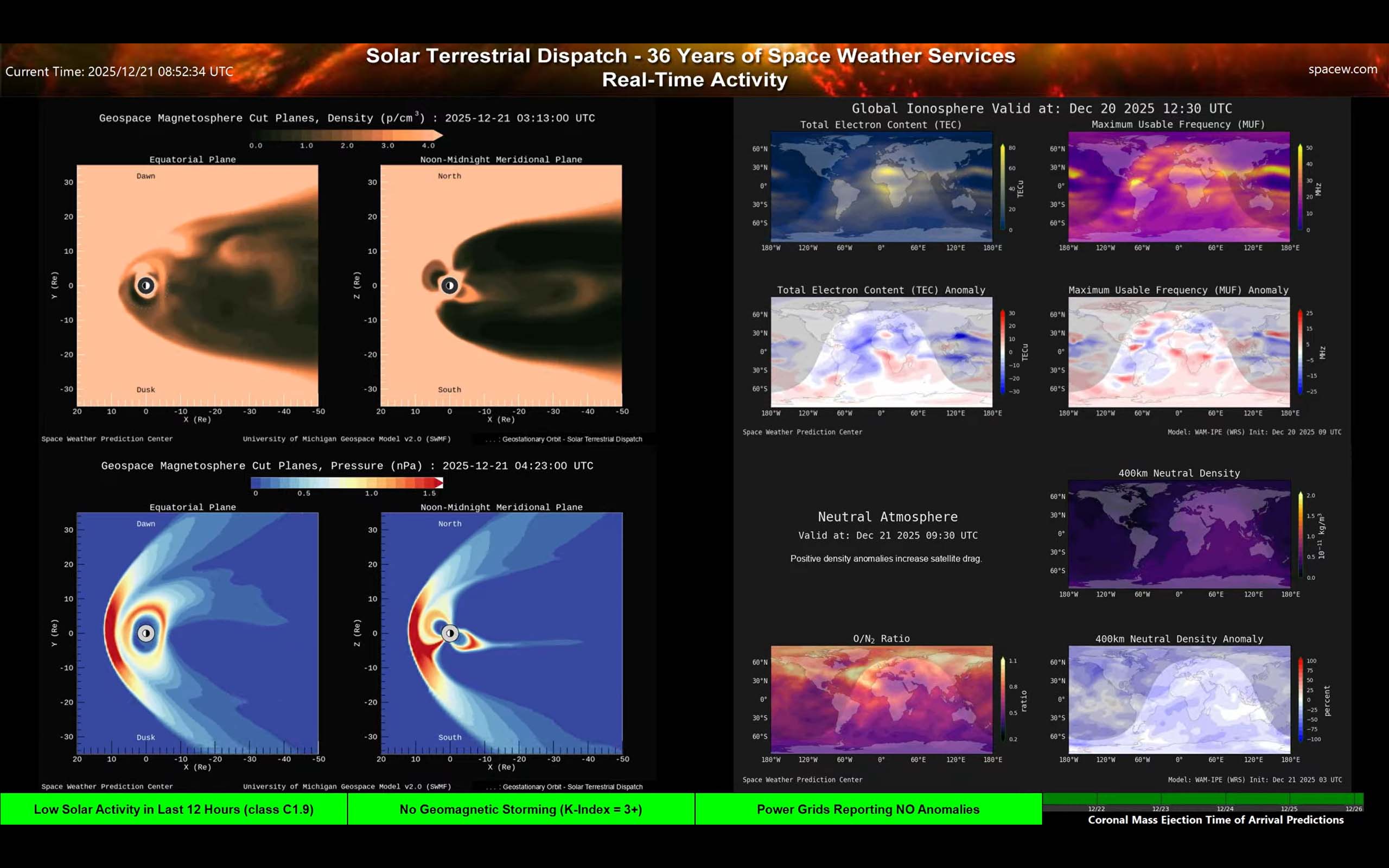
Screen 9 — Earth Impacts: Magnetosphere + TEC + MUF + Neutral Atmosphere Anomalies
Summary
This screen is about practical impacts on Earth systems. It combines models of Earth’s magnetosphere with ionosphere maps (TEC and MUF for radio/GNSS) and a neutral-atmosphere anomaly panel used as a proxy for upper-atmosphere heating and satellite drag risk.
More detail
Left side: Magnetosphere model (cut planes)
- Density and pressure snapshots from a model of Earth’s magnetic ‘bubble’ in the solar wind.
- Why it matters: A compressed or strongly structured magnetosphere can accompany active space-weather conditions.
Right side: Ionosphere maps — TEC and MUF (HF communications)
- TEC (Total Electron Content): How many free electrons are overhead. Important for GPS/GNSS accuracy and signal delays.
- MUF (Maximum Usable Frequency): A key HF radio metric — the highest frequency that is likely to work for long-distance HF propagation at that time.
- Anomaly versions: “How unusual is this compared to typical conditions?” These can be easier for beginners to read quickly.
Bottom-right: Neutral atmosphere anomalies (heating / satellite drag)
- What it shows: Unusual changes in upper-atmosphere density (often around satellite-relevant altitudes).
- Why it matters: When the upper atmosphere is heated during geomagnetic activity, it expands (“puffs up”), increasing density where satellites orbit → more drag and faster orbital decay.
Practical tip: If you care about communications, watch MUF. If you care about GPS quality, watch TEC. If you care about satellite operations, watch neutral density anomalies.