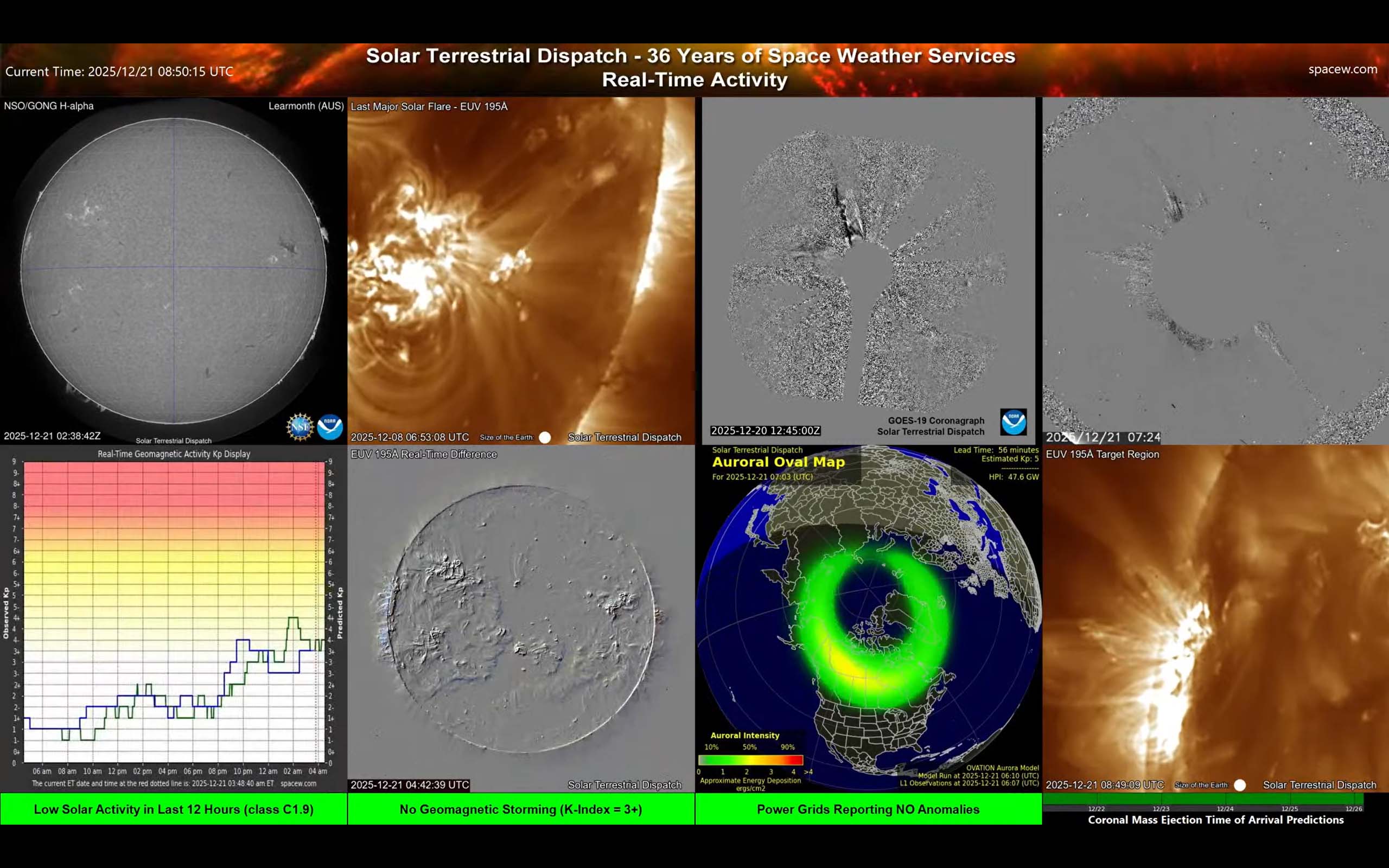
Screen 4 — Quick Geomagnetic Status: Kp Activity Display + Aurora Context
Summary
This screen is identical to Screens 1 through 3, except that the lower-left image changes. That plot is a simple global geomagnetic indicator (Kp) and is used to describe how 'stormy' the geomagnetic field is.
More detail
The key new panel here: the Kp activity display
- Kp is a global index from 0 to 9 describing how disturbed Earth’s magnetic field is.
- How to read it: Higher Kp means stronger geomagnetic activity and broader aurora reach.
- Rule of thumb: Kp ~3 is “unsettled to active,” Kp ~5 is “storm level,” and values above that are stronger storms. A magnetic storm is when the Earth's magnetic field 'shakes' and is less stable. Shaking magnetic fields can induce electrical currents in long conductive objects such as power lines and pipelines.
How to read it
- Blue trace: Represents the estimated last 3-hours of global geomagnetic activity using magnetographs from locations around the world.
- Green/Red trace: This is the predicted level of geomagnetic activity using available real-time solar wind data from spacecraft as inputs to deep neural network models. A green trace represents periods of little concern. A red trace denotes periods of heightened concern (when the shakiness of the Earth's magnetic field might cause problems).
- Kp Strength: The Kp index is represented in thirds, as follows: Kp of 0 represents dead-quiet conditions (the most stable the Earth's field can be). The next step up is a level of "1-", followed by "1o", then "1+", then "2-", "2o", "2+", and so on until a peak value of 9 is reached (the maximum Kp value possible).
Practical tip: If you’re new, Kp is a great "headline" number. It gives an instant indication of the state of the Earth's geomagnetic field. The current Kp value is also indicated in the bottom-middle-left bar.