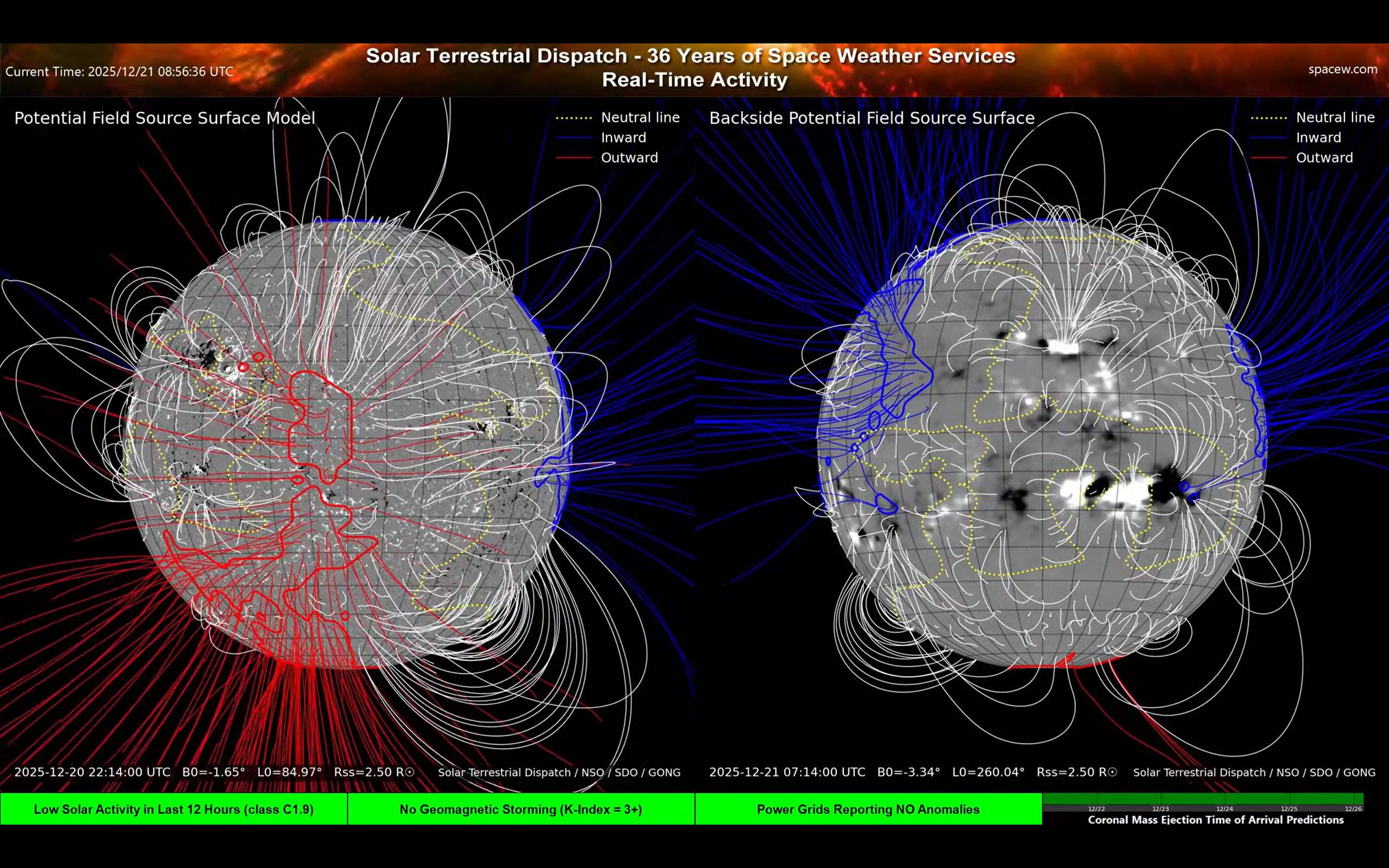
Screen F — PFSS Magnetic Field Model (front side + backside)
Summary
The Potential Field Source Surface (PFSS) is a model that sketches the Sun’s large-scale magnetic field lines based on surface observations. It helps explain where magnetic fields are open to space (often linked to solar wind sources) versus closed in loops (active-region arcades).
More detail
What the lines represent
- Field lines: A model of the coronal magnetic structure.
- Open fields: Lines that extend outward (red) or inward from space (blue) — often associated with coronal holes and solar wind streams.
- Closed loops: Lines that connect back to the Sun (white) — often prominent around active regions.
- Neutral line: A yellow dotted boundary line where magnetic polarity changes; related to large-scale structure in the heliosphere.
- Inferred Coronal Holes: Open magnetic fields that extend into space are where coronal holes live. High velocity solar wind streams can emanate from these locations, which can cause geomagnetic storms and auroral activity on the Earth. The red and blue outlined boundaries are inferred coronal hole regions based solely on the PFSS model of the Sun's magnetic field. Other indicators (such as dark areas in 193 Angstrom images) can be used with these to help increase confidence in the location and shape of coronal holes.
Front side vs backside
- Front side is based on direct observations and is generally more reliable.
- Backside is based on data one-half of a solar rotation earlier. Treat it as a broad hint of what could rotate into view in the future. The backside features that rotate around the limb on the right-side of the image are the features that become visible to us right now.
Practical tip: This screen is best for building intuition about the global structure of the Sun's magnetic field and for increasing confidence in identifying the location and shape of coronal holes.