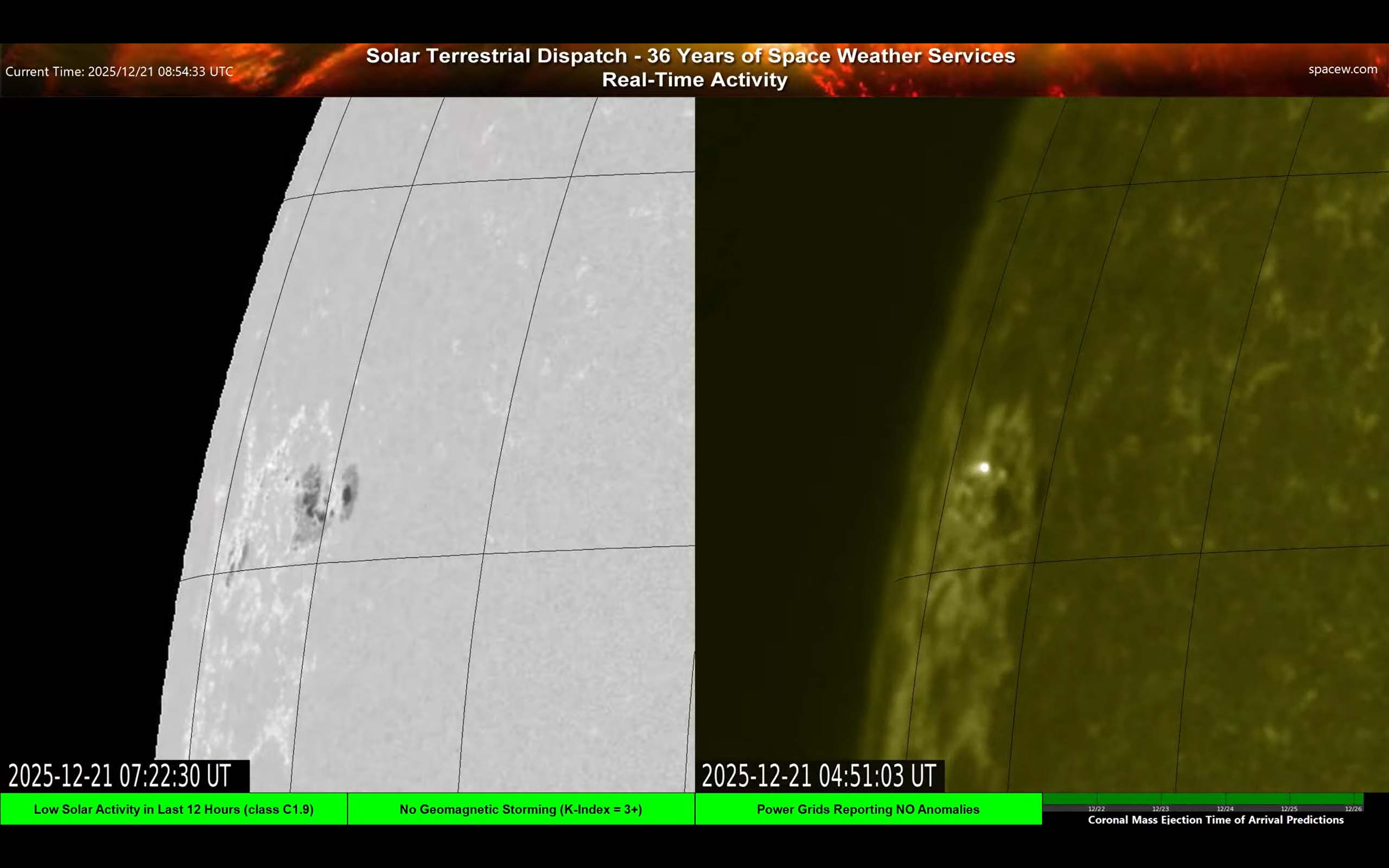
Screen C — Split Context View (surface/magnetic context vs UV/EUV activity)
Summary
This is a simple, high-value pairing: one panel gives surface/magnetic context (where the active sunspot region is), and the other shows the hotter atmospheric emission (what’s brightening and evolving above it).
More detail
Why this screen exists
People often struggle to connect “where the region is” with “what it’s doing.” This view makes that connection immediate: you can locate the active region on the surface and then see how the atmosphere above it is behaving.
What to look for
- Are the sunspots closely clustered together? This can increase magnetic shear and solar flare potential.
- Brightening or loop expansion in UV/EUV that sits above a magnetically complex patch.
- Changes over time (check the timestamps).
Practical tip: Sunspots can evolve quickly (in a matter of hours). Clusters of darker sunspots (umbrae) within a less dark penumbral area are important, especially if the magnetic fields are of opposite magnetic polarity known as magnetic delta configurations (confirm using Screens 6, 7 or F). Such areas, when combined with magnetic shear (Screens 7 or 8) can lead to significant solar flares.