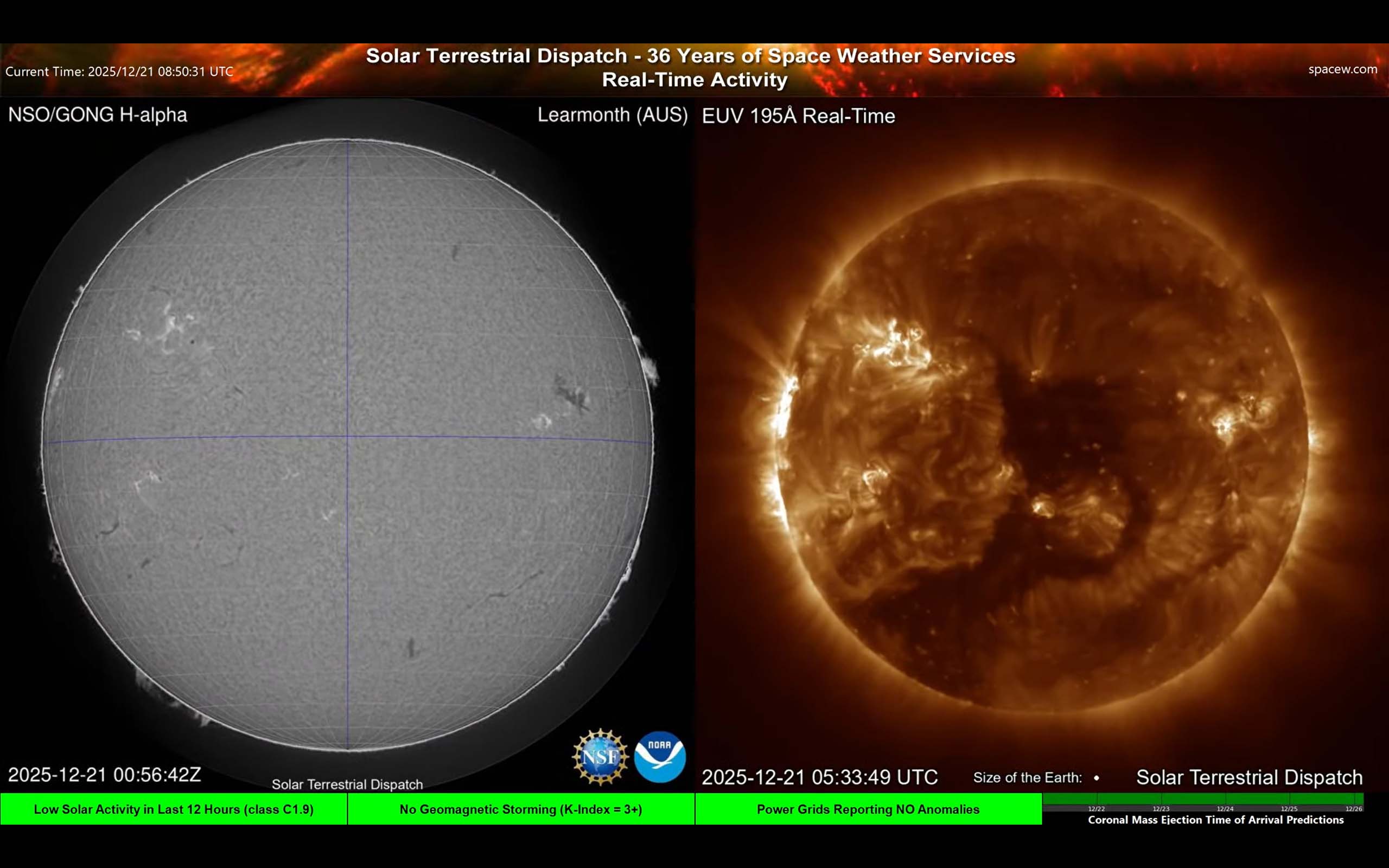
Screen 5 — Simple Two-Panel Sun View (H-alpha vs EUV 195Å)
Summary
This is the simplest beginner screen: it shows the Sun in two complementary ways side-by-side. H-alpha highlights features in the lower solar atmosphere (filaments/prominences), while EUV 195Å highlights the million-degree corona (loops, active regions, coronal holes).
More detail
Left: H-alpha (chromosphere)
- What it’s best at: Viewing prominences and solar filaments (both are structures of cooler gas suspended above the hotter surface of the Sun by magnetic fields - the difference is that prominences appear brighter against the solar limb). The physical size of solar flares are also traditionally measured and rated in H-alpha.
- Why it matters: Filaments can sometimes erupt, and those eruptions can be part of larger events.
Right: EUV 195Å (hot corona)
- What it’s best at: Bright coronal loops over active regions and large dark patches called coronal holes.
- Why it matters: Active regions are solar flare/eruption candidates; coronal holes can be sources of faster solar wind streams.
Practical tip: Bright regions are not necessarily flares. Flares are momentary brightenings, but active sunspot groups are also associated with higher temperatures, which naturally appear brighter in EUV imagery.